


Case Study: Every Link Matters: How One Year of TILT Adira Reads Built Readers in K–2

Reading growth isn’t one thing. It’s a chain, and every link matters.
When a kindergartner truly masters letter names and sounds, first grade doesn’t spend the year re-teaching what should already be there — it builds. When first grade builds, second grade reaches for fluency. And when second grade reaches fluency, third grade becomes the year a child reads to learn, instead of struggling to learn to read.
Break a link in kindergarten, and you spend years trying to weld it back together. Forge it strong, and the chain holds.
This year, in a K–2 cohort of 152 students using TILT Adira Reads, we watched the chain hold.
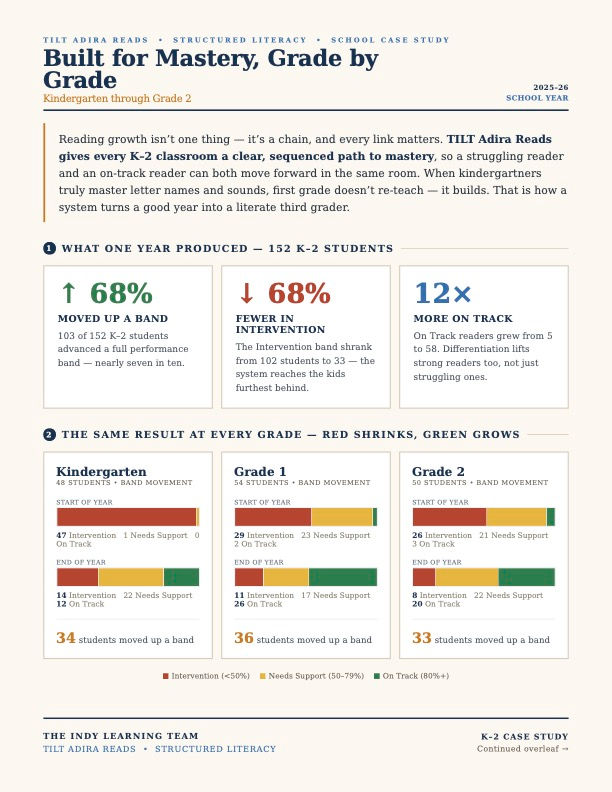
What One Year Produced
103 of 152 students — 68% — moved up a full performance band. Children who started in the Intervention band dropped from 102 to 33 — a 68% reduction. At the same time, the On Track band grew from 5 students to 58.
That second number matters as much as the first. A program that only moves struggling readers leaves strong readers parked. A program that only celebrates strong readers leaves the kids who need it most behind. This year, both groups grew — in the same classrooms, under the same curriculum. That’s what real differentiation looks like.
And it wasn’t one lucky grade. The same pattern showed up in Kindergarten, Grade 1, and Grade 2 — three teaching teams, one consistent result. That isn’t a lucky cohort. That’s a system doing what it was built to do.
Why It Works
Most reading programs cover skills. TILT Adira Reads focuses on mastery of skills.
The difference is everything. Covered skills get checked off whether students learned them or not, and the gaps accumulate quietly until they surface in third grade as a reader who suddenly can’t keep up. Mastered skills are gated — there are explicit benchmarks every child needs to reach to stay on the road to full literacy by the end of third grade.
A clear scope and sequence makes those checkpoints visible. Consistent instruction means a child’s growth doesn’t depend on which adult they happen to get. Across this K–2 cohort, mastery of those must-have benchmarks rose an increase of 24% to 57% depending on the grade — children entering the next grade actually ready for it.

Every Skill Secured Is a Skill the Next Teacher Doesn’t Have to Re-Teach
That’s not a metaphor. That’s how reading develops.
The K–2 years are where third grade is decided. Get the chain right, and third grade is a celebration. Leave links open, and third grade is a recovery effort that often never fully recovers.
If you’re a school leader wondering whether your current program is forging that chain — we’d love to talk.
To learn more about partnering with The Indy Learning Team and bringing TILT Adira Reads to your school, contact us. The full K–2 case study, with grade-by-grade data and implementation insights, is available on request.


Comments